
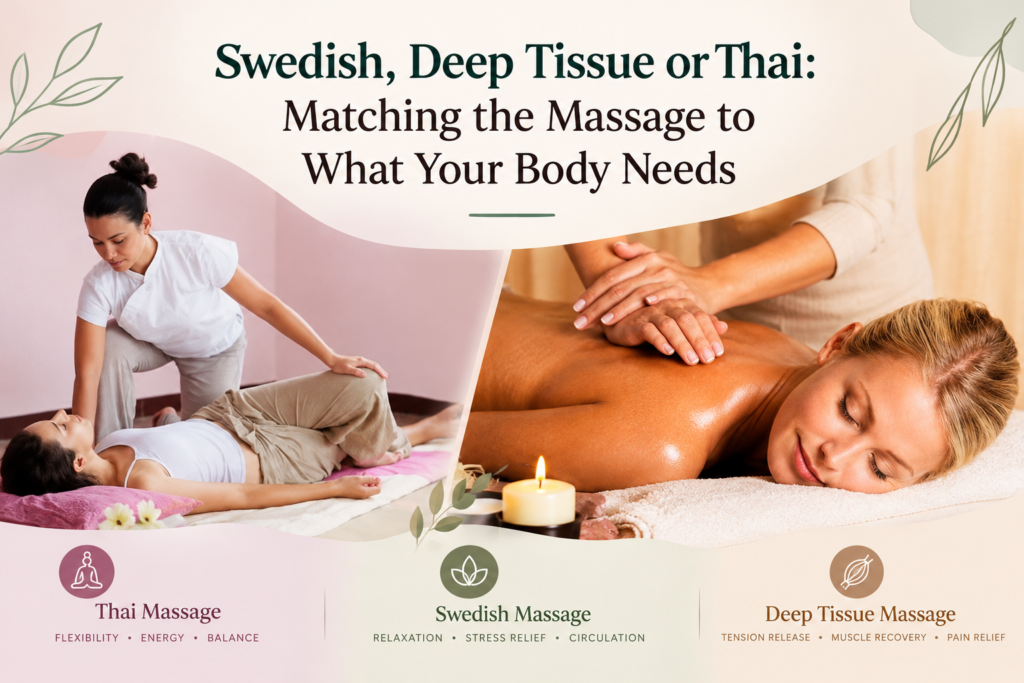
Swedish, Deep Tissue or Thai: Matching the Massage to What Your Body Needs
Stand in front of almost any spa menu and the choices can feel like a foreign language. Swedish, deep tissue, Thai, Balinese, aromatherapy, trigger point, hot stone: each sounds appealing, and none comes with clear instructions. Most guests end up picking whichever name sounds familiar, and some leave wondering why the session felt too light, too firm or simply not what they needed. The good news is that choosing a massage does not have to be a guessing game. Once you understand what each style does and how it feels, the decision becomes much easier. This guide explains the main styles in plain language, shows you how to match them to your day and your body, and covers how to talk to a therapist, what to expect during a session and what to do afterwards. It is written with busy Mumbai professionals in mind, especially anyone searching for a body massage in Bandra, but the advice applies wherever you book. Why the right style matters A massage is not one single thing. The same hour on the table can feel very different depending on the technique, the pressure and the pace. A flowing, gentle session can leave you feeling sleepy and calm. A firm, targeted session can leave you feeling looser in the shoulders but a little tender the next day. A stretching session can feel energising. None of these is better than the others. They simply do different jobs. When the style does not match your needs, the experience can disappoint. Someone who wanted to switch off after a hectic week may feel uncomfortable during a deep tissue session. Someone with tight shoulders from desk work may find a light, relaxing massage pleasant but not quite enough. Matching the style to your goal is the simplest way to get more from your time and money. It also helps to remember that massage may help relieve muscle tension and support relaxation, but it is not a medical treatment. A reputable spa will never promise to cure an illness or guarantee a result. If you have a health condition, an injury or are pregnant, talk to your doctor first. Start with the pressure scale Before looking at individual styles, think about pressure, because it affects almost everything else. Light pressure is gentle and soothing, usually with flowing strokes. It suits first-timers, sensitive guests and anyone who mainly wants to relax. Medium pressure is firmer without being intense. Many people find this the sweet spot for general muscle tension. Firm pressure uses slower, deeper work on tight areas. It can produce a satisfying sense of release, but it should never be painful. A useful rule is that a massage should feel like good discomfort at most, never sharp or burning pain. If you tense up, hold your breath or grit your teeth, the pressure is too much. A good therapist will check in, but you should also speak up. Swedish massage: the relaxing classic Swedish massage is probably the most widely known style. The therapist uses long, gliding strokes, kneading and gentle circular movements, usually with oil, to warm the muscles and encourage a calm, unhurried feeling. Best for: first-time guests, stress and general tiredness, people who want to switch off, and anyone unsure what to choose. What it feels like: smooth, rhythmic and soothing. Pressure is usually light to medium, though many therapists can adjust it. Good to know: if you are new to massage, Swedish is a safe starting point. You can always ask for firmer pressure in the areas that need it. Deep tissue massage: for stubborn tension Deep tissue massage uses slower strokes and firmer pressure to work on the deeper layers of muscle. It is commonly chosen by people who feel tightness in the neck, shoulders, upper back or lower back, which is common among people who sit at desks or use laptops for much of the day. Best for: desk-related tension, tight shoulders, a stiff back, and people who find light massage not quite enough. What it feels like: focused and firm. You may feel a stretching or pressing sensation on tight spots. Some people feel mildly sore the day after, which is usually short-lived, but sharp pain is not normal and you should tell the therapist straight away. Good to know: deep tissue does not mean the therapist should lean in as hard as possible. Slow, steady pressure that you can breathe through is the goal. If you have an injury, recent surgery, a bleeding disorder or take certain medications, check with your doctor first. Thai massage: stretching and rhythm Thai massage works differently from oil-based styles. The therapist uses hands, thumbs, forearms and sometimes feet to apply pressure along the body, and moves you through assisted stretches. It is often done on a mat or low bed, and guests are commonly given loose, comfortable clothing rather than being draped and oiled, though this varies between spas. Best for: guests who like to feel stretched, people who sit for long hours and want to loosen up their hips and legs, and anyone who prefers a more active session over a purely relaxing one. What it feels like: rhythmic pressing and stretching, with the therapist guiding your limbs into positions. It can feel energising rather than sleepy. Good to know: if you are very stiff or have joint problems, tell the therapist so the stretches stay within a comfortable range. Never force a stretch. Balinese massage: the middle ground Balinese massage blends long strokes, gentle stretches, acupressure-style pressing and sometimes aromatic oils. It sits between Swedish and deep tissue in feel, which makes it popular with guests who want a session that is relaxing but still has some substance. Best for: guests who like a varied, flowing session and are comfortable with medium pressure. What it feels like: a combination of smooth strokes and firmer pressing, often accompanied by a pleasant scent. Aromatherapy massage: scent and calm Aromatherapy massage pairs gentle massage techniques with essential
Swedish, Deep Tissue or Thai: Matching the Massage to What Your Body Needs Read More »