
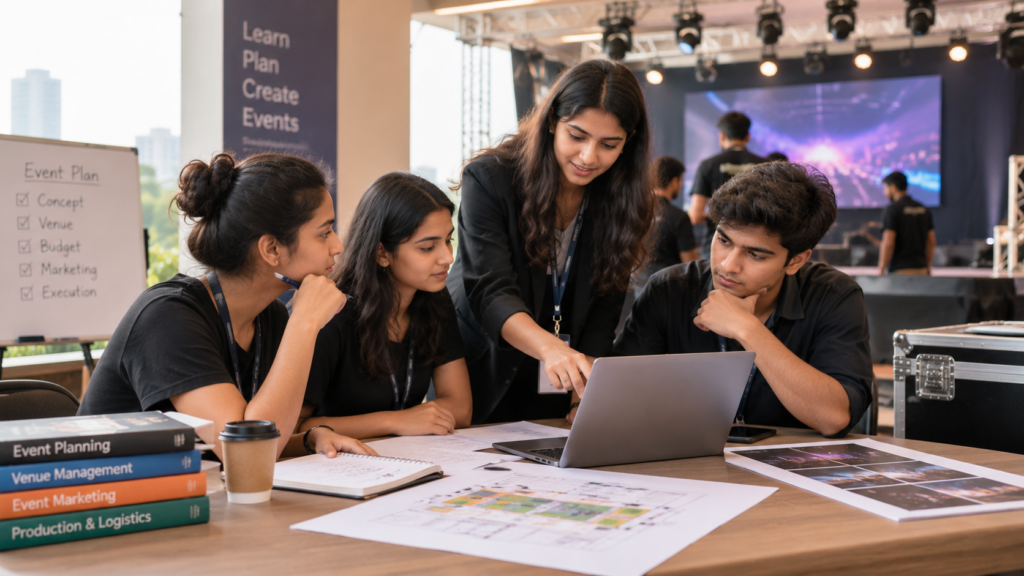
For a long time, planning a big event in India was something you learned by being thrown into it. An uncle who was good with people took charge of the wedding. A college senior who could handle a microphone ran the annual fest. There was no syllabus and no handbook, and very few people thought of it as a profession of its own.
That has changed. Today, event management sits next to marketing, media and hospitality as a career people choose on purpose. This guide looks at how that shift happened, what formal event education adds, and what it means if you are a student or parent in Indore comparing your options.
From family favour to full-time profession
Events used to be organised by whoever happened to be available. Families ran weddings, a few experienced hands ran stage shows, and whichever department had spare time ran the corporate programme.
Then the scale grew. Brands began launching products in front of live audiences. Television shows and concerts got bigger. Conferences needed proper planning. The work became too large and too technical to leave to chance. Budgets had to be tracked, vendors coordinated, artists scheduled, permissions arranged and safety planned.
Someone had to be responsible for all of it, and that someone became the event manager.
Why events needed formal training
Learning on the job works, up to a point. But it is slow, and mistakes at a live event happen in front of everyone. A sound system fails, a vendor does not turn up, the guest list doubles an hour before the doors open.
Formal training helps because it teaches the repeatable parts before you face them. You learn how to build a budget, how to read a vendor contract, how to put together a run-of-show, and how to plan for the “what if” moments. It also gives students a shared language, so a trained coordinator and a trained producer understand each other quickly.
Just as important, training teaches the business side. An event is a project with money, deadlines and people, and a good idea alone does not get it delivered.
The institute that helped put event education on the map
NIEM, The Institute of Event Management, says it was founded in 2000 by Dr. Hoshi Bhiwandiwalla and describes itself as Asia’s first event management institute. Its stated aim from the start was to produce a trained and qualified workforce for the events and entertainment industry, and to create a new professional class of event managers, event coordinators and consultants.
You can have your own view on titles like “first”, but the idea behind it was clear. Events deserved the same structured education that other professions already had.
What this means for students in Indore
If you are in Central India, you no longer have to look far from home to study this field. NIEM Indore offers event management programmes in the city.
Indore is also a busy place for weddings, business gatherings and cultural programmes, which can give students plenty of real events to watch and learn from. For event management, being in a city that hosts a lot of events is an advantage, because the subject is learned best around live work.
What good event education looks like
Whatever institute you look at, these are the things worth checking:
- Live exposure. Does the course take you to real events, or is it mostly classroom theory?
- Industry faculty. Are the people teaching you working in events themselves?
- Business basics. Do you learn budgeting, contracts and vendor handling, not just décor and themes?
- Networking. Will you meet people from the industry before you graduate?
- Soft skills. Events test your calm, your communication and your ability to lead a team under pressure.
Frequently asked questions
Is event management a real career?
Yes. Weddings, corporate events, conferences, concerts, exhibitions and brand activations all need trained people to plan and run them. Many students find that the field offers a wide mix of roles.
Do I need a degree before joining an event management course?
It depends on the programme. Some courses are open to students after Class 12 and others to graduates, so it is best to ask the institute directly which one fits you.
Is practical training really more useful than theory?
Both matter, but event skills are hard to learn from books alone. Many students find that working on live events teaches them things a classroom cannot.
How do I choose an event management institute in Indore?
Visit the campus, meet the faculty, ask what live events students work on, and compare the programmes against the checklist above.
Final thoughts
Event education exists because the industry grew up. What was once a favour between friends is now a profession with training, roles and career paths. If you are thinking about it seriously, visit the campus and ask the institute directly about fees, course duration and admissions before you decide.